For over a century, workplace safety has been built on a clear and practical foundation: identify physical hazards, assess risks and implement controls to prevent injury or illness. This approach has saved countless lives and remains essential in industries such as manufacturing, construction, mining and chemical processing. However, in the age of artificial intelligence (AI), this traditional model is increasingly showing its limitations.
The modern workplace is no longer defined solely by physical machinery or environmental exposure. Instead, it is shaped by intelligent systems that make decisions, monitor performance and influence human behavior in real time. AI and robotics are transforming industries at every level, from automated production lines and autonomous logistics systems to algorithm-driven hiring platforms and predictive management tools. While these innovations reduce physical risk, they introduce a new category of workplace hazards that traditional safety frameworks were never designed to address.
One of the most significant gaps is the inability of conventional safety models to account for psychological and cognitive risk. In AI-enabled workplaces, employees are often subject to continuous digital monitoring. Their productivity, behavior and even communication patterns may be tracked and analyzed by algorithms. This creates a form of constant surveillance that can increase stress, reduce autonomy and contribute to emotional fatigue. Unlike physical hazards, these risks are invisible, cumulative and difficult to measure using traditional safety metrics.
Another challenge lies in algorithmic decision-making. AI systems are increasingly involved in evaluating employee performance, assigning tasks and influencing managerial decisions. However, these systems often operate as “black boxes,” offering little transparency into how outcomes are determined. This lack of clarity can erode trust, create uncertainty and leave workers feeling disconnected from decision-making processes that directly affect their careers.
Traditional workplace safety frameworks also struggle to address the rapid pace of technological change. Historically, safety systems were designed to respond to stable environments where hazards could be identified and controlled over time. AI, however, evolves continuously. Machine learning systems adapt, update and refine themselves, meaning that workplace risks are no longer static; they are dynamic and constantly shifting.
Global institutions are increasingly recognizing these challenges. The World Economic Forum has highlighted the profound impact AI will have on labor markets and workplace structures, emphasizing the need for new governance models. Similarly, McKinsey & Company has reported that without proper oversight, AI adoption may contribute to increased burnout, workforce instability and widening inequality across industries.
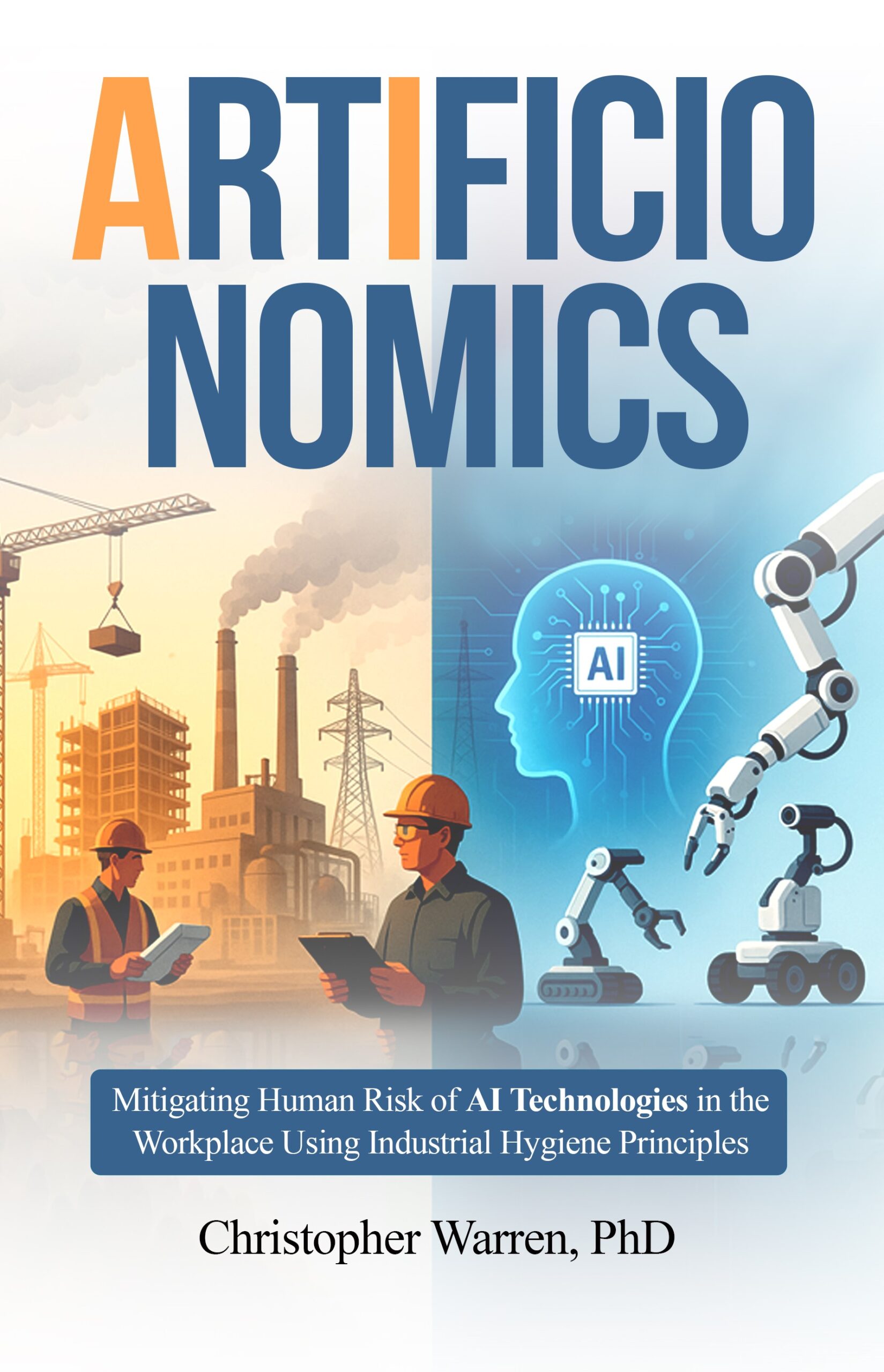
This growing gap between traditional safety models and modern technological realities is precisely what Christopher Warren addresses in his groundbreaking book ArtificIonomics.
ArtificIonomics introduces a new framework for workplace safety designed specifically for the age of artificial intelligence and robotics. It expands the definition of industrial hygiene beyond physical hazards to include cognitive, psychological and ethical risks introduced by intelligent systems.
At its core, ArtificIonomics proposes that safety must evolve in three key stages: identify, evaluate and control. First, organizations must identify AI-related risks such as surveillance pressure, reduced autonomy, cognitive overload and algorithmic bias. Second, these risks must be evaluated using both traditional performance metrics and human-centered indicators like trust, fairness perception and psychological well-being. Finally, control strategies must be implemented through transparent AI governance, ethical system design and workforce training focused on human-machine collaboration.
The central argument is clear: traditional safety models are not failing because they are wrong; they are failing because the nature of work has changed.
As AI continues to reshape industries, safety must expand its focus from preventing physical harm to protecting human experience itself. This means ensuring that workers are not only physically safe but also mentally supported, ethically respected and meaningfully engaged.
ArtificIonomics offers a timely and necessary evolution of safety thinking. It provides organizations with a practical roadmap for addressing the unseen risks of AI while ensuring that technological progress does not come at the expense of human well-being.
Available On Amazon: https://www.amazon.com/dp/B0GFY4RL6B/