Artificial intelligence is often introduced into the workplace with a promise of progress, faster systems, safer operations and smarter decision-making. Across industries, AI is already doing exactly that. It streamlines production lines, supports logistics networks, assists in healthcare and optimizes administrative processes with remarkable precision. On the surface, this looks like a clear step forward.
But beneath this progress lies something far less visible: a growing psychological cost that is quietly reshaping the human experience of work.
Unlike traditional workplace risks, which are usually physical and immediately identifiable, AI introduces pressures that are subtle, continuous and difficult to measure. These are not hazards that break bones or damage equipment. They affect attention, trust, confidence and emotional stability.
One of the most significant shifts is the rise of constant digital monitoring. In many workplaces, AI systems now track performance in real time, measuring output, speed, accuracy and even behavioral patterns. While this is often framed as a tool for efficiency and safety, it also creates an environment where employees may feel perpetually observed.
That feeling matters. When people believe every action is being recorded and evaluated, the workplace changes. Autonomy becomes cautious. Creativity becomes restrained. Stress becomes normalized. Even simple tasks begin to carry the weight of evaluation.
A second, more complex issue is algorithmic decision-making. Increasingly, AI systems influence decisions about workloads, scheduling, hiring and performance reviews. Yet these systems are often not fully transparent. Workers are expected to trust outcomes they cannot see or fully understand.
This lack of clarity introduces a quiet but persistent strain. When decision-making becomes opaque, uncertainty grows. And where uncertainty grows, trust tends to weaken. Over time, this can lead to disengagement, frustration and emotional fatigue even in technically efficient workplaces.
These challenges are not hypothetical. Global institutions have already begun to raise concerns. The World Economic Forum has highlighted how AI is reshaping the global workforce and increasing the need for responsible transition strategies. Similarly, McKinsey & Company has noted that while AI brings productivity gains, it also carries risks related to burnout, stress and workforce disruption when poorly managed.
What becomes clear is that workplace safety frameworks built for the industrial age are struggling to keep up. They were designed to manage physical dangers, not psychological pressure created by intelligent systems that observe, decide and adapt continuously.
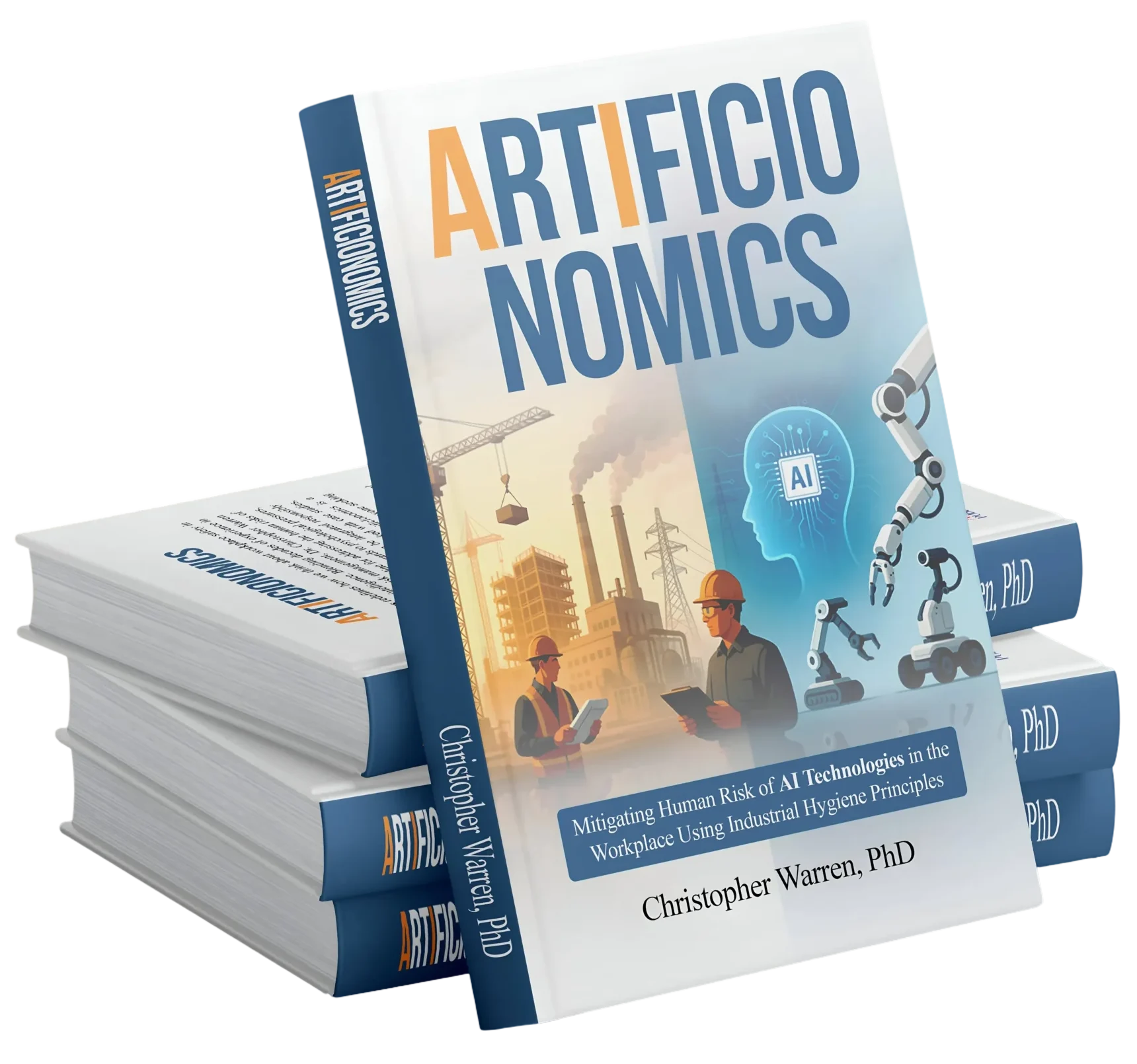
This is the gap addressed by Christopher Warren in his work ArtificIonomics.
Rather than treating AI as purely a technical upgrade, ArtificIonomics asks a more fundamental question: What happens to people when work becomes governed by intelligent systems?
The answer begins with expanding how we define risk. ArtificIonomics builds on industrial hygiene principles but extends them into the digital environment. It recognizes that modern workplace hazards include not only physical exposure, but also psychological strain, cognitive overload and ethical uncertainty.
The framework it proposes is structured but practical: identify risks created by AI systems, evaluate their impact using both operational and human-centered measures and control them through transparent design, ethical governance and supportive workplace practices.
At its core, the approach is not about resisting AI. It is about ensuring that its integration does not quietly erode human well-being in the process of improving efficiency.
Because the real question is no longer whether AI will change work, it already has. The more urgent question is whether workplaces will adapt in a way that protects the people inside them.
ArtificIonomics offers a structured way to confront that question clearly, practically and with the human experience at its center.
Available On Amazon: https://www.amazon.com/dp/B0GFY4RL6B/