For more than a century, occupational health has focused on protecting workers from visible hazards.
Industrial hygienists measured chemical exposures. Safety professionals reduced physical risks. Organizations developed systems to prevent injuries, illnesses and workplace accidents. These efforts transformed workplaces and saved countless lives.
But today, a new challenge is emerging.
Artificial Intelligence is rapidly reshaping how people work, make decisions, interact with technology and experience the workplace itself. As AI becomes integrated into virtually every industry, occupational health professionals face a critical question:
How do we protect workers from risks we cannot always see?
The answer may define the future of occupational health in the 21st century.
A New Generation of Workplace Hazards
The workplace hazards of the future will not always be physical.
Increasingly, they will be psychological, cognitive, social and ethical.
Employees are already working alongside intelligent systems that monitor productivity, assign tasks, guide decisions and influence performance evaluations. AI-powered tools can increase efficiency, but they can also create unintended consequences.
Workers may experience stress from constant surveillance. They may struggle with cognitive overload as they interpret complex algorithmic outputs. Others may face uncertainty about job security, concerns about privacy or anxiety about working alongside increasingly autonomous systems.
Unlike traditional hazards, these risks often leave no immediate physical evidence. Yet their impact on employee well-being, engagement and long-term health can be substantial.
Occupational health professionals can no longer focus solely on protecting the body.
They must also help protect the mind.
The Evolution of Occupational Health
Every industrial revolution has forced workplace safety practices to evolve.
When factories introduced dangerous machinery, safety protocols followed. When chemical exposures became widespread, industrial hygiene emerged as a discipline. When ergonomics became a concern, organizations adapted work environments to reduce strain and injury.
Artificial Intelligence represents the next major shift.
As intelligent systems become part of everyday operations, occupational health must expand beyond traditional risk categories. New assessment methods will be needed to evaluate psychological stress, cognitive fatigue, algorithmic pressure and the broader human consequences of automation.
The future of occupational health will require professionals to understand not only physical exposures, but also human-machine interactions and the effects of digital work environments.
Why Traditional Frameworks Need to Evolve
Many organizations are investing heavily in AI technologies but have not yet developed systems to evaluate their impact on workers.
This creates a dangerous gap.
Technology may be deployed successfully from an operational standpoint while simultaneously creating burnout, disengagement, distrust or emotional strain among employees.
The challenge is not simply managing AI.
It is managing the human experience of AI.
Organizations that fail to recognize this reality may discover that the costs of innovation extend far beyond technology budgets.
Introducing Artificionomics
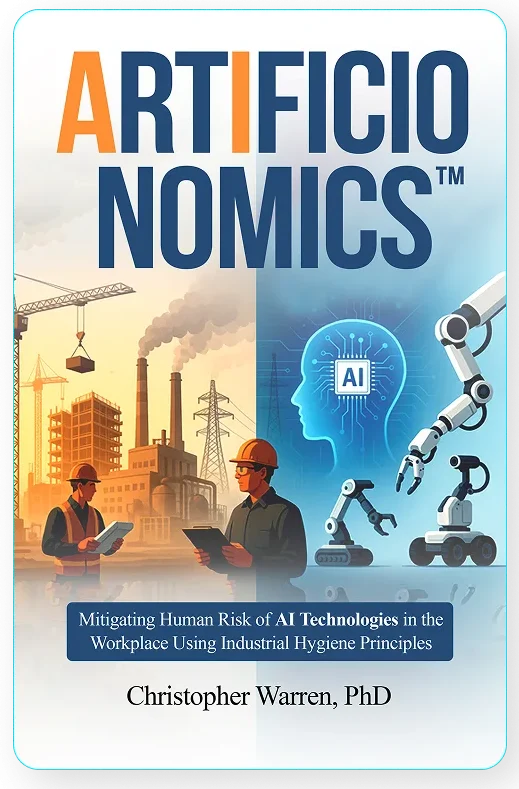
This challenge inspired Christopher Warren, PhD, to develop Artificionomics, a groundbreaking discipline designed specifically for the age of artificial intelligence.
In his book, Artificionomics: Mitigating Human Risk of AI Technologies in the Workplace Using Industrial Hygiene Principles, Warren introduces a practical framework for identifying, evaluating and controlling the human risks associated with AI and robotics.
Drawing from industrial hygiene, occupational health, psychology, safety science and AI governance, Artificionomics provides a roadmap for organizations seeking to embrace innovation while protecting employee well-being.
Rather than viewing AI solely as a technology challenge, the framework positions it as a workplace health and human performance issue.
Building Healthier Workplaces in the AI Era
The future of occupational health will not be defined by technology alone.
It will be defined by how effectively organizations protect people while adopting that technology.
The most successful workplaces of tomorrow will be those that recognize that productivity and well-being are not competing priorities. They are complementary goals.
As AI continues to transform industries, occupational health professionals have an opportunity to play a leadership role in shaping a safer, healthier and more human-centered future of work.
Artificionomics offers a vision for that future one where innovation and worker well-being advance together, ensuring that progress never comes at the expense of the people it is meant to serve.