In industries where a single mistake can have catastrophic consequences, every second matters. Whether it’s an oil refinery, a mining operation, a construction site, a manufacturing plant or a power generation facility, workers face hazards that demand constant vigilance. For decades, organizations have relied on inspections, maintenance schedules and safety procedures to reduce these risks.
Today, artificial intelligence is introducing a powerful new capability: the ability to predict hazards before they become incidents.
Predictive AI is rapidly changing how organizations approach workplace safety. By analyzing massive volumes of operational data from sensors, equipment, wearables and connected systems, AI can identify patterns that humans might never detect. It can forecast equipment failures, recognize unsafe conditions, anticipate maintenance needs and alert organizations before small problems escalate into major accidents.
For high-risk industries, this isn’t just an operational improvement; it has the potential to save lives.
Imagine a mining operation where AI detects abnormal vibration in a haul truck hours before a mechanical failure occurs. Consider a manufacturing facility where predictive analytics identify an overheating motor before it sparks a fire. Picture a construction project where intelligent monitoring systems recognize unsafe worker movements near heavy equipment and trigger immediate alerts.
These are no longer futuristic scenarios. They are becoming part of everyday operations across industries, embracing digital transformation.
Yet while predictive AI offers extraordinary opportunities, technology alone cannot eliminate workplace risk.
Every AI-generated alert still depends on human interpretation. Every recommendation requires sound judgment. Every intelligent system operates within a workplace shaped by people, processes and organizational culture.
That is where many organizations face a new challenge.
As AI becomes more deeply integrated into safety programs, workers and supervisors must learn to interpret automated recommendations, trust or question algorithmic insights and collaborate effectively with intelligent systems. Over-reliance on automation can create complacency, while poorly designed systems may generate excessive alerts, contributing to cognitive overload and decision fatigue. Even the most sophisticated predictive model cannot replace human experience, critical thinking or ethical decision-making.
This is why the future of workplace safety is not simply about adopting smarter technology; it is about managing the human risks that accompany it.
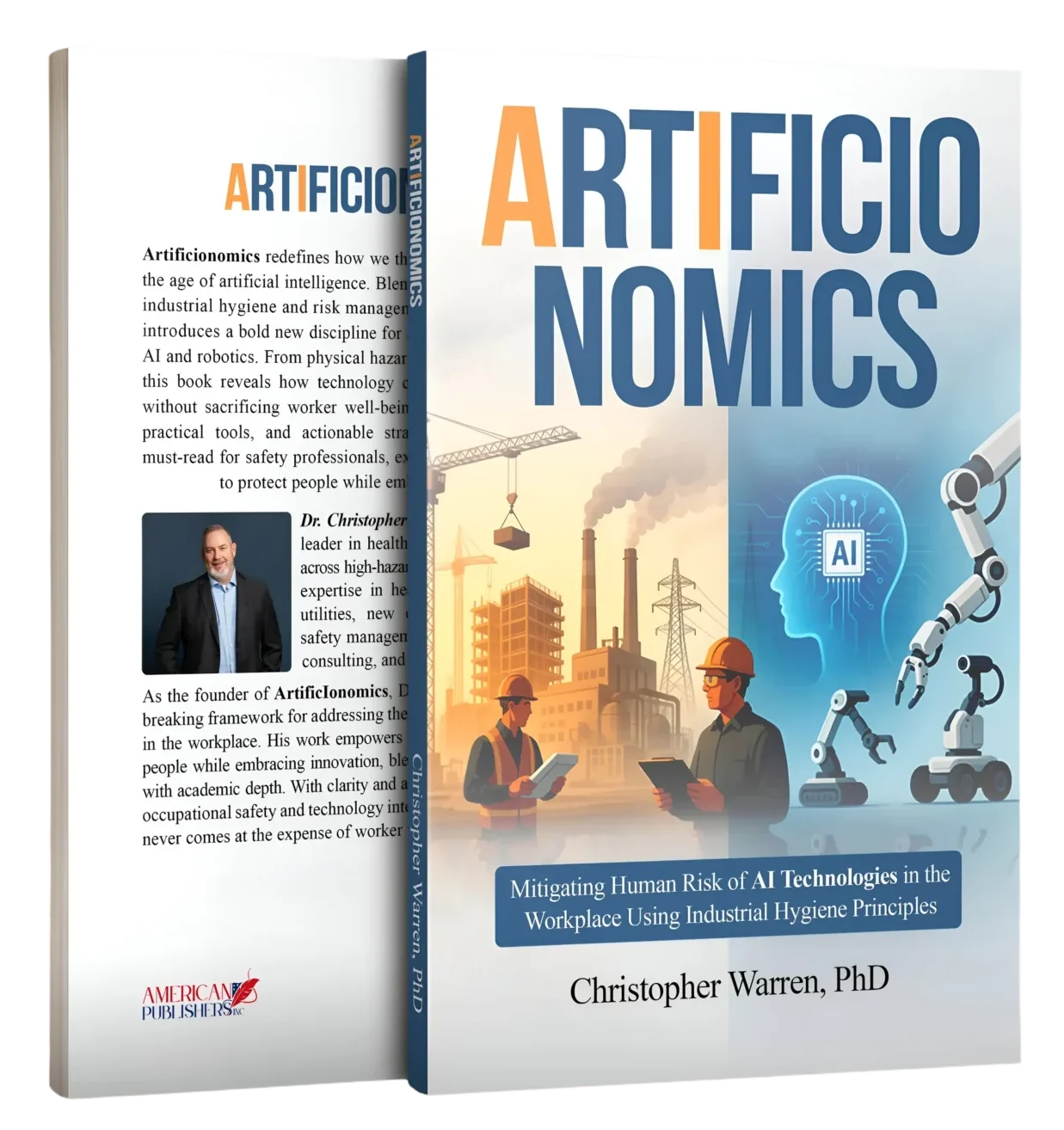
In ArtificIonomics: Mitigating Human Risk of AI Technologies in the Workplace Using Industrial Hygiene Principles, Christopher Warren, PhD, introduces a groundbreaking framework that bridges the gap between artificial intelligence and occupational health. Drawing on the proven principles of industrial hygiene, the book demonstrates how organizations can systematically identify, evaluate and control not only traditional workplace hazards but also the emerging cognitive, psychological, ethical and organizational risks created by AI technologies.
Rather than viewing AI solely as a tool for improving efficiency, ArtificIonomics encourages safety professionals and business leaders to recognize intelligent systems as a new category of workplace exposure. The framework expands traditional risk management to include human-AI interaction, algorithmic decision-making, digital fatigue, predictive monitoring and worker well-being, ensuring that technological innovation strengthens, not compromises, occupational safety.
For organizations operating in high-risk industries, this perspective offers a significant competitive advantage. Predictive AI can help prevent incidents before they occur, but its greatest value is realized only when paired with strong governance, continuous workforce training, transparent safety policies and a commitment to protecting the people behind the technology.
The future of workplace safety will be increasingly predictive rather than reactive.
But the organizations that lead this transformation will understand an essential truth: the smartest safety systems are those that combine artificial intelligence with human intelligence.
ArtificIonomics provides the roadmap for achieving that balance, helping organizations harness the life-saving potential of predictive AI while ensuring that worker health, dignity and safety remain at the center of every technological advancement.