Every generation faces a workplace transformation that changes how organizations operate, how employees work and how leaders manage risk.
The Industrial Revolution introduced machinery and manufacturing systems that reshaped labor. The Information Age brought computers, networks and digital workflows. Today, Artificial Intelligence is driving another transformation, one that may be even more disruptive than the changes that came before it.
Organizations are rapidly deploying AI to automate tasks, analyze data, guide decisions, monitor performance and collaborate with workers in ways that were unimaginable just a few years ago.
But amid the excitement surrounding AI, an important question remains largely unanswered:
Who is managing the human risks that come with intelligent technologies?
Most organizations have frameworks for cybersecurity risk, financial risk, operational risk and regulatory compliance. Yet very few have a structured approach for identifying and controlling the ways AI can affect employee health, well-being, trust, decision-making and workplace culture.
That gap is becoming increasingly difficult to ignore.
As AI becomes more deeply integrated into daily operations, workers are experiencing challenges that traditional safety and management systems were never designed to address. Concerns about job displacement, algorithmic bias, workplace surveillance, cognitive overload, loss of autonomy and human-robot interaction are becoming part of the modern workplace experience.
These are not simply technology issues.
They are human issues.
And they require a discipline specifically designed to address them.
This is where ArtificIonomics enters the conversation.
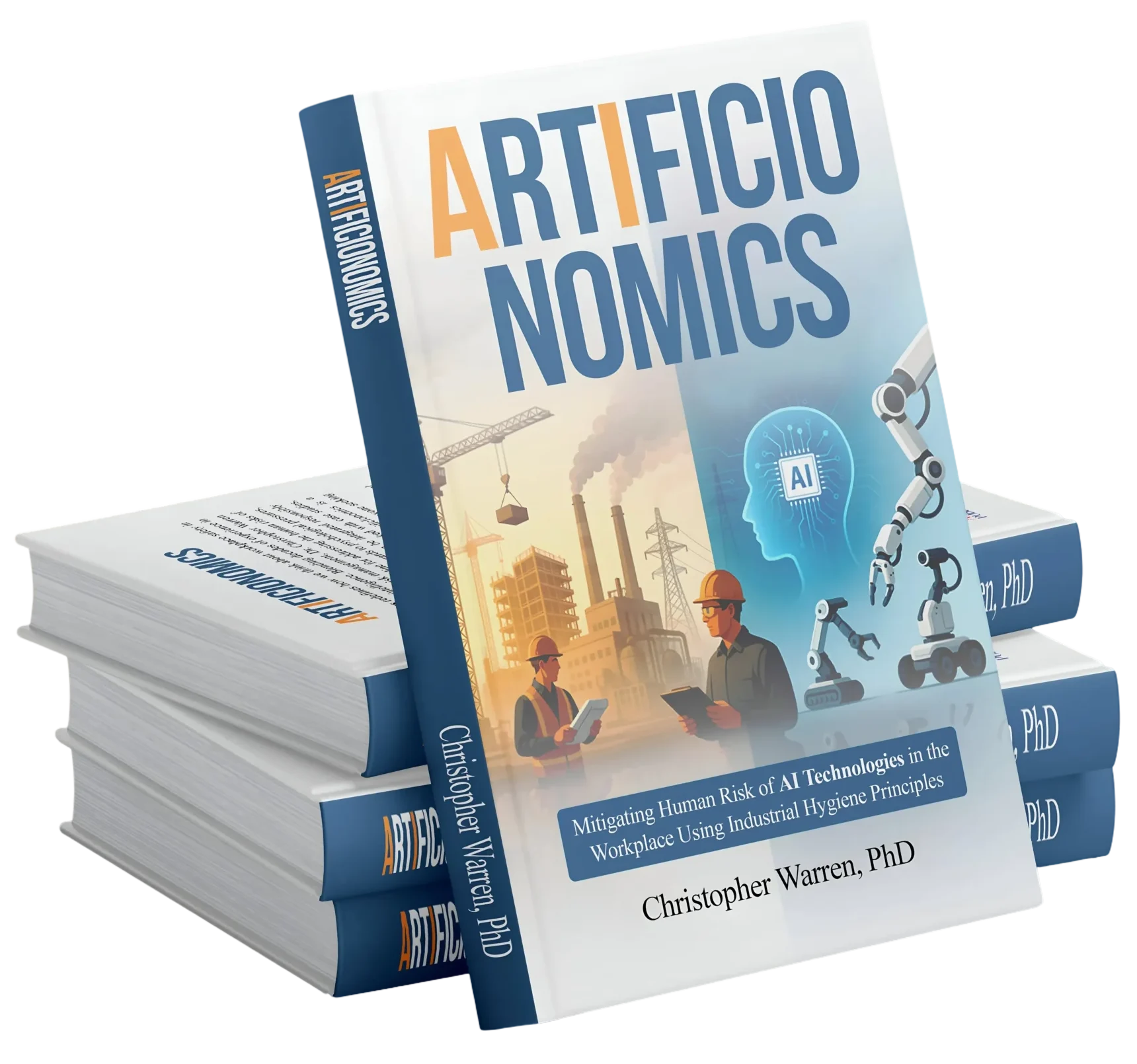
Introduced by Christopher Warren, PhD, in ArtificIonomics: Mitigating Human Risk of AI Technologies in the Workplace Using Industrial Hygiene Principles, ArtificIonomics represents a groundbreaking approach to managing the human impact of artificial intelligence and robotics.
At its core, ArtificIonomics applies the proven principles of industrial hygiene to the AI-driven workplace. For decades, industrial hygiene professionals have protected workers by identifying hazards, evaluating exposures and implementing controls to reduce risk. This methodology has been instrumental in addressing chemical, physical, biological and ergonomic hazards across countless industries.
ArtificIonomics extends that same logic into the digital age.
Instead of focusing solely on traditional workplace exposures, it examines the cognitive, psychological, social, ethical and operational risks associated with AI technologies. It asks organizations to treat AI not merely as a business tool, but as a workplace exposure capable of influencing worker health, performance and well-being.
This shift in perspective could prove transformative.
Just as cybersecurity emerged as a critical discipline when organizations became dependent on digital networks, ArtificIonomics may emerge as an essential discipline as organizations become dependent on intelligent systems.
Forward-thinking leaders are already recognizing that successful AI adoption requires more than technical excellence. It requires trust. It requires transparency. It requires governance. And most importantly, it requires protecting the people who interact with AI every day.
The organizations that thrive in the coming decade will not simply be those that deploy the most advanced technologies. They will be the ones that understand how those technologies affect human beings and take proactive steps to manage those impacts.
That is precisely what ArtificIonomics seeks to accomplish.
As AI continues to reshape industries around the world, the need for a dedicated framework to address human risk will only grow. Safety professionals, HR leaders, executives, policymakers and technology teams will all play a role in ensuring that innovation does not come at the expense of worker well-being.
The next decade will be defined by how effectively organizations balance technological advancement with human needs.
If that prediction proves true, ArtificIonomics may become one of the most important workplace disciplines of our time.
Because the future of work is not just about building smarter machines.
It is about creating workplaces where people can thrive alongside them.