For more than a century, industrial hygiene has played a critical role in protecting workers from workplace hazards.
Whether identifying chemical exposures, controlling noise levels, mitigating ergonomic risks or preventing occupational illnesses, industrial hygiene has provided organizations with a proven framework for safeguarding human health. Its core mission has always been simple: anticipate, recognize, evaluate and control workplace hazards before they harm people.
But what happens when the hazards are no longer physical?
What happens when the workplace itself is being transformed by artificial intelligence, robotics, automation and algorithmic decision-making?
The answer may lie in a groundbreaking new discipline known as Artificionomics.
The Workplace Has Changed, So Must Our Safety Frameworks
Every industrial revolution has introduced new risks.
The steam era brought machinery hazards. The manufacturing age introduced chemical and physical exposures. The digital revolution created concerns around repetitive strain injuries, screen fatigue and information overload.
Today, Artificial Intelligence is creating a completely new category of workplace risk.
Employees are increasingly working alongside intelligent systems that monitor productivity, guide decisions, assign tasks, evaluate performance and interact directly with customers. AI-powered robots are entering factories, warehouses, construction sites, healthcare facilities and critical infrastructure environments.
While these technologies offer extraordinary opportunities, they also introduce risks that traditional safety programs were never designed to address.
Stress from workplace surveillance. Cognitive overload from constant human-AI interaction. Anxiety related to job displacement. Algorithmic bias. Loss of autonomy. Reduced trust in decision-making systems.
These hazards may not be visible, but they are real.
And they demand a new framework.
The Evolution from Industrial Hygiene to Artificionomics
Industrial hygiene has long relied on a simple but powerful process:
Identify. Evaluate. Control.
Christopher Warren, PhD, recognized that these same principles could be applied to the emerging risks created by artificial intelligence and robotics.
The result is Artificionomics, a pioneering discipline focused on understanding and mitigating the human risks associated with AI technologies in the workplace.
Rather than treating AI solely as a technology issue, Artificionomics views it through the lens of occupational health, safety, human performance and organizational well-being.
The framework asks questions many organizations have yet to consider:
- How does AI affect employee mental health?
- What are the risks of algorithmic management?
- How should organizations evaluate AI-related stressors?
- What controls can reduce human exposure to AI risks?
- How can innovation be balanced with worker well-being?
These questions are becoming increasingly important as AI adoption accelerates across industries.
Why Organizations Need a Human-Centered Approach
Many organizations focus heavily on the operational benefits of AI.
They measure efficiency gains, cost reductions, automation rates and productivity improvements.
But technology does not operate in isolation.
Every AI system ultimately affects people.
Employees interact with it. Managers rely on it. Customers experience it. Leaders make decisions based on it.
Without a structured approach to managing human risk, organizations may unintentionally create environments where stress, distrust, burnout and disengagement become hidden costs of innovation.
Artificionomics provides a roadmap for preventing those outcomes.
A Blueprint for the Future of Work
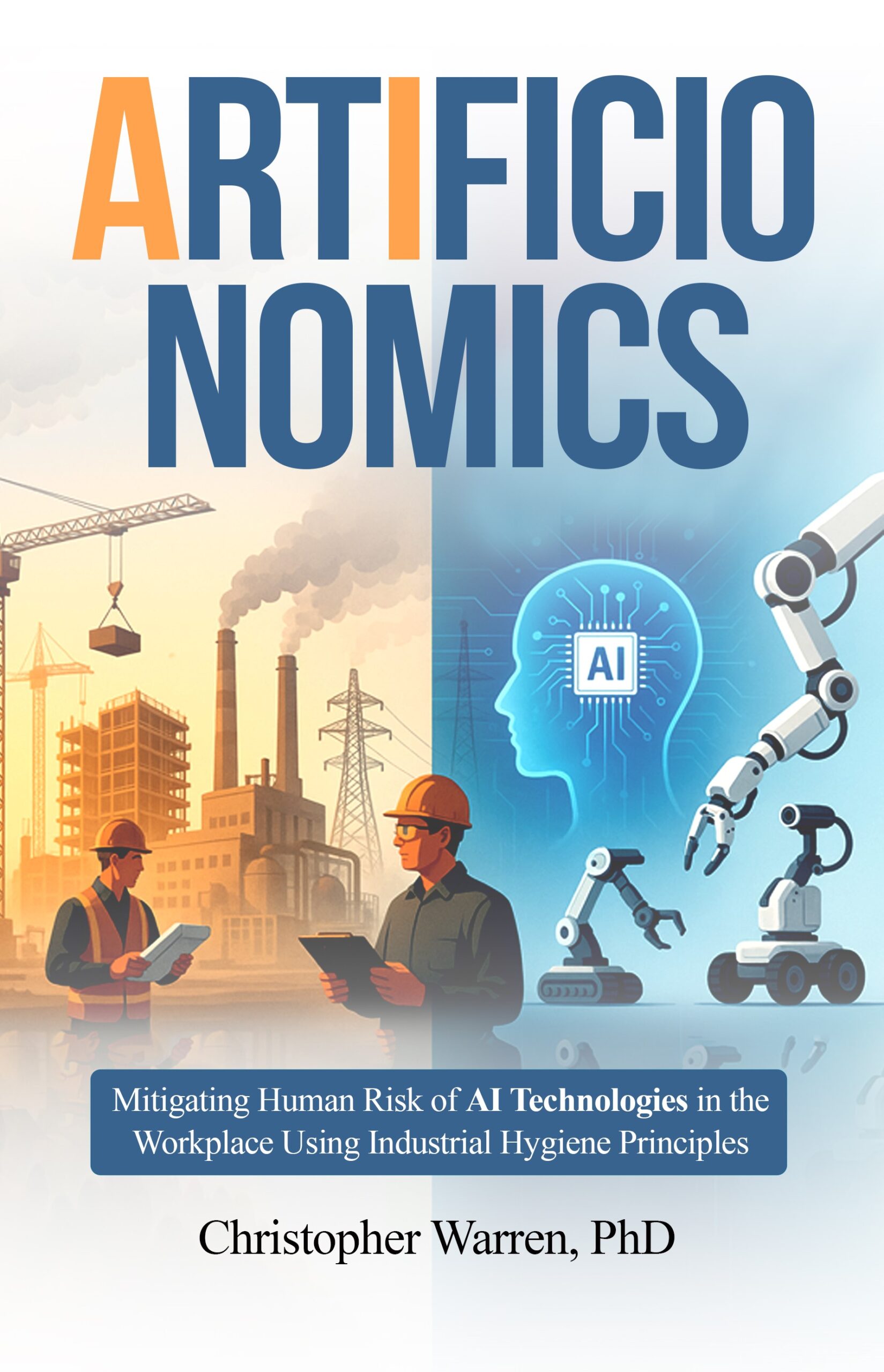
In his groundbreaking book, Artificionomics: Mitigating Human Risk of AI Technologies in the Workplace Using Industrial Hygiene Principles, Christopher Warren, PhD, introduces a practical framework for organizations navigating the AI revolution.
By combining industrial hygiene, occupational health, psychology, safety science and AI governance, Artificionomics offers a new way of thinking about workplace risk in an increasingly automated world.
The future of work will not be defined solely by how advanced our technologies become.
It will be defined by how effectively we protect the people who use them.
Industrial hygiene transformed workplace safety during the previous industrial revolutions.
Artificionomics has the potential to do the same for the AI age.
And for organizations committed to innovation without sacrificing human well-being, that future cannot come soon enough.