For more than a century, workplace safety professionals have focused on protecting workers from hazards that could be seen, measured and controlled.
Chemical exposures. Airborne contaminants. Excessive noise. Radiation. Heat stress. Hazardous machinery.
These risks shaped the development of modern occupational health and safety programs. Through industrial hygiene principles, organizations learned how to identify hazards, assess exposures and implement controls that protected workers from harm.
The results have been remarkable.
Countless injuries, illnesses and fatalities have been prevented through systematic risk management and a commitment to worker well-being.
But the workplace is changing.
As Artificial Intelligence becomes increasingly integrated into business operations, a new category of workplace hazards is emerging, one that many organizations are only beginning to recognize.
These are algorithmic hazards.
Unlike chemical hazards, algorithmic hazards are not always visible. They cannot be detected through air sampling or measured with a noise meter. They do not come with warning labels or safety data sheets.
Yet their impact on workers can be just as significant.
Today’s employees are working alongside AI systems that monitor performance, assign tasks, evaluate productivity, recommend decisions and influence workplace outcomes. Intelligent technologies are reshaping how work is performed, how decisions are made and how organizations manage their workforce.
While these innovations create tremendous opportunities, they also introduce new forms of risk.
Employees may experience stress from continuous digital monitoring. Workers may feel anxiety about job displacement as automation expands. AI-driven decision-making can create concerns about fairness, transparency and accountability. Cognitive overload can occur when employees are required to interpret and respond to constant streams of algorithm-generated information.
In some environments, workers may become overly dependent on automated systems, reducing critical thinking and situational awareness. In others, human-robot interaction can create entirely new safety considerations.
These risks may not result in immediate physical injury, but they can affect mental health, job satisfaction, trust, performance and overall workplace well-being.
The challenge is that most traditional safety programs were not designed to address them.
Historically, industrial hygiene focused on physical, chemical, biological and ergonomic hazards. AI introduces exposures that are psychological, cognitive, social, ethical and organizational in nature.
As intelligent technologies become more deeply embedded in workplaces, organizations need a framework capable of addressing these emerging risks.
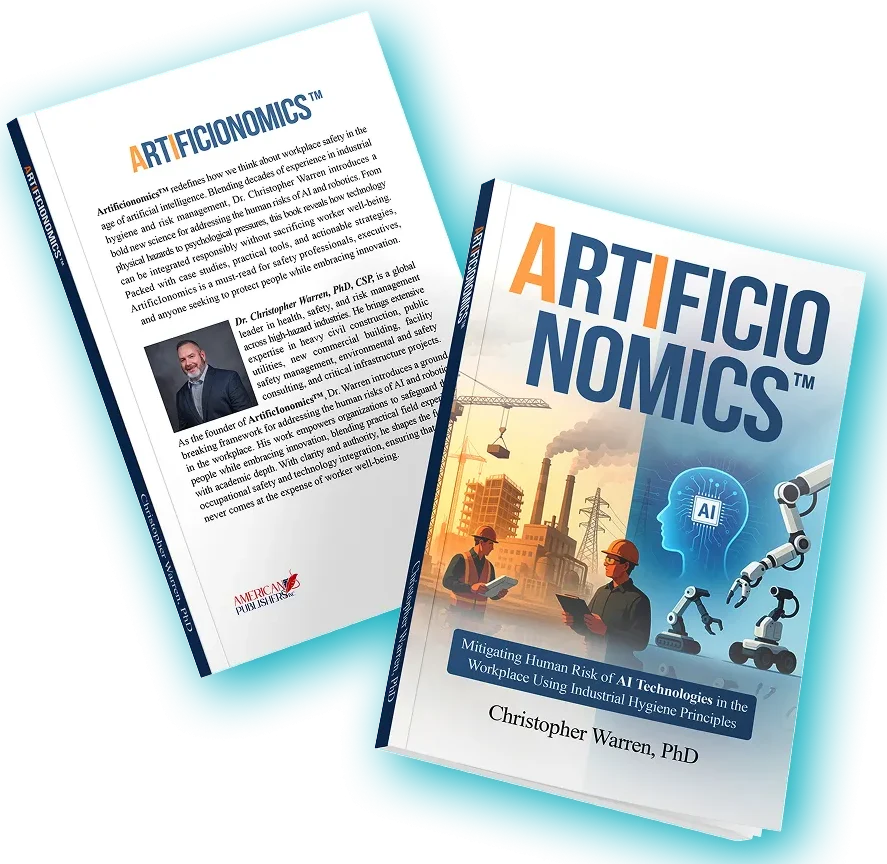
This is the central idea behind ArtificIonomics: Mitigating Human Risk of AI Technologies in the Workplace Using Industrial Hygiene Principles by Christopher Warren, PhD.
The book introduces ArtificIonomics, a groundbreaking discipline that applies the proven methodology of industrial hygiene to the human risks associated with artificial intelligence and robotics. Rather than treating AI solely as a technological advancement, ArtificIonomics recognizes it as a workplace exposure that can influence worker health, safety, performance and well-being.
Using familiar industrial hygiene concepts such as hazard identification, exposure assessment, risk evaluation and control implementation, the framework provides organizations with a practical approach to managing AI-related risks before they become larger organizational problems.
The comparison is both simple and powerful.
In the twentieth century, organizations learned how to manage chemical hazards.
In the twenty-first century, they must learn how to manage algorithmic hazards.
The future of workplace safety will not be limited to protecting workers from what they can physically see and touch. It will also involve understanding the invisible ways intelligent systems affect human behavior, decision-making, mental health and workplace culture.
Organizations that recognize this shift early will be better prepared for the future.
Because as AI continues to transform the workplace, the next frontier of occupational health and safety will not be found in factories, laboratories or equipment rooms.
It will be found in the algorithms shaping the modern world of work.
And that is precisely why ArtificIonomics matters.