Artificial intelligence is rapidly transforming healthcare. From supporting medical imaging and predicting disease progression to streamlining administrative tasks and assisting with clinical decision-making, AI promises to improve patient outcomes while helping healthcare systems manage growing demands.
For hospitals facing workforce shortages, rising patient volumes and increasing operational complexity, these technologies appear to offer an ideal solution.
But there is a question healthcare leaders cannot afford to overlook:
Can AI improve patient care without increasing staff burnout?
The answer depends not only on the technology itself but on how it is implemented.
AI has already demonstrated remarkable potential across healthcare. Intelligent systems can analyze medical images with impressive accuracy, identify high-risk patients earlier, optimize hospital resource allocation and automate repetitive documentation that consumes valuable clinician time. Predictive analytics can even help identify conditions such as sepsis before symptoms become critical, enabling earlier intervention and potentially saving lives.
These innovations are changing healthcare for the better.
Yet behind every AI-powered recommendation stands a physician, nurse, technician or healthcare professional responsible for making the final decision.
That human element is where new challenges begin to emerge.
As AI becomes integrated into clinical workflows, healthcare professionals must process increasing volumes of algorithm-generated alerts, interpret complex recommendations and balance machine intelligence with clinical judgment. Rather than eliminating pressure, AI can sometimes shift it, creating new forms of cognitive workload and decision fatigue.
Clinicians may begin to wonder whether they should trust their experience or the algorithm. Continuous alerts can contribute to “alert fatigue,” while automated workflows may unintentionally reduce professional autonomy if every decision appears to be guided by software instead of human expertise.
Over time, these hidden pressures can contribute to stress, emotional exhaustion and burnout, ironically undermining one of healthcare’s most valuable resources: its people.
Protecting healthcare workers requires more than adopting better technology. It requires a new way of thinking about workplace risk.
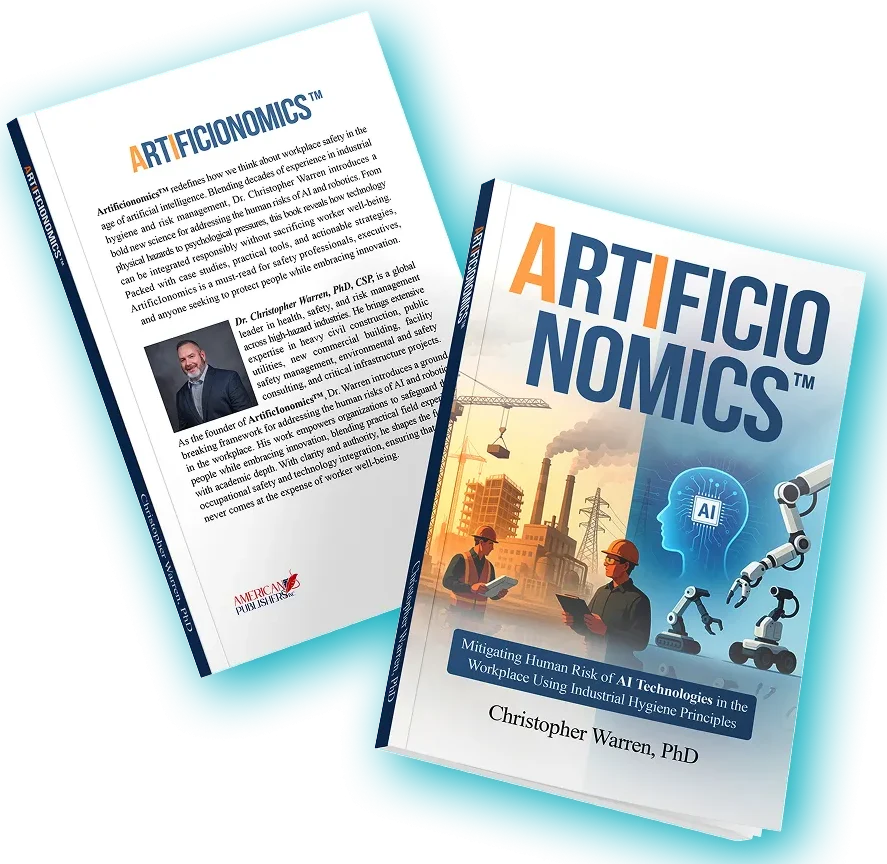
In ArtificIonomics: Mitigating Human Risk of AI Technologies in the Workplace Using Industrial Hygiene Principles, Christopher Warren, PhD, introduces a pioneering framework that applies the proven principles of industrial hygiene to the emerging human risks created by artificial intelligence. Rather than focusing solely on technical performance, the book encourages organizations to evaluate how AI affects the physical, cognitive, psychological and ethical well-being of the workforce.
The book expands traditional workplace safety beyond biological, chemical and ergonomic hazards to include AI-specific exposures such as cognitive overload, algorithmic bias, surveillance, digital fatigue and the complex relationship between humans and intelligent systems. Using the familiar industrial hygiene process of identifying, evaluating and controlling hazards, ArtificIonomics offers practical guidance for integrating AI responsibly into healthcare environments.
For healthcare leaders, this perspective is especially important. Successful AI adoption is not measured simply by faster diagnoses or greater operational efficiency. It is measured by whether clinicians remain empowered, engaged and capable of delivering compassionate, high-quality care.
That means investing in AI literacy, maintaining meaningful human oversight, designing intuitive clinical workflows and creating governance frameworks that place healthcare professionals, not algorithms, at the center of patient care.
Artificial intelligence has enormous potential to improve medicine. It can help clinicians make faster decisions, reduce administrative burdens and uncover insights hidden within vast amounts of medical data.
But technology alone cannot deliver exceptional healthcare.
The future of medicine will belong to organizations that recognize a simple truth: healthier patients depend on healthier caregivers.
ArtificIonomics provides a timely roadmap for achieving that balance, demonstrating that the most successful healthcare systems of the AI era will be those that embrace innovation while protecting the people whose expertise, compassion and judgment remain irreplaceable.