Few companies have transformed global logistics as dramatically as Amazon. By combining artificial intelligence, robotics, automation and sophisticated data analytics, Amazon has redefined how goods are stored, picked, packed and delivered. Orders that once took days to process can now move through highly automated fulfillment centers in a matter of hours.
The results are impressive. Faster deliveries, greater inventory accuracy, improved operational efficiency and an increasingly connected supply chain have raised the standard for logistics worldwide.
But as the industry races toward greater automation, one question deserves equal attention:
What happens to worker safety when artificial intelligence becomes a co-worker?
For decades, warehouse safety focused on familiar hazards, such as forklift traffic, heavy lifting, repetitive motion, slips and falls and manual material handling. AI-powered robotics has helped reduce many of these risks by taking over physically demanding, repetitive and hazardous tasks. Autonomous mobile robots now transport inventory, optimize warehouse routes and reduce unnecessary walking for employees.
These innovations represent genuine progress.
Yet automation is also creating an entirely new generation of workplace risks.
Today’s warehouse employee doesn’t simply lift boxes; they collaborate with intelligent machines, monitor automated workflows, respond to algorithm-driven performance systems and adapt to constantly evolving technologies. As physical demands decrease in some areas, cognitive and psychological demands often increase.
Workers may experience pressure from AI-driven productivity metrics, stress from continuous digital monitoring, uncertainty about changing job responsibilities and concerns about how automation will affect their long-term careers. Human-robot collaboration also introduces new safety considerations, requiring employees to understand how autonomous systems behave and how to interact safely with them in fast-moving environments.
These challenges are not flaws in artificial intelligence; they are reminders that every technological revolution changes the nature of occupational risk.
Traditional safety programs excel at managing physical hazards. They are less equipped to address algorithmic management, digital fatigue, cognitive overload and the human factors associated with increasingly intelligent workplaces.
This is where a new framework becomes essential.
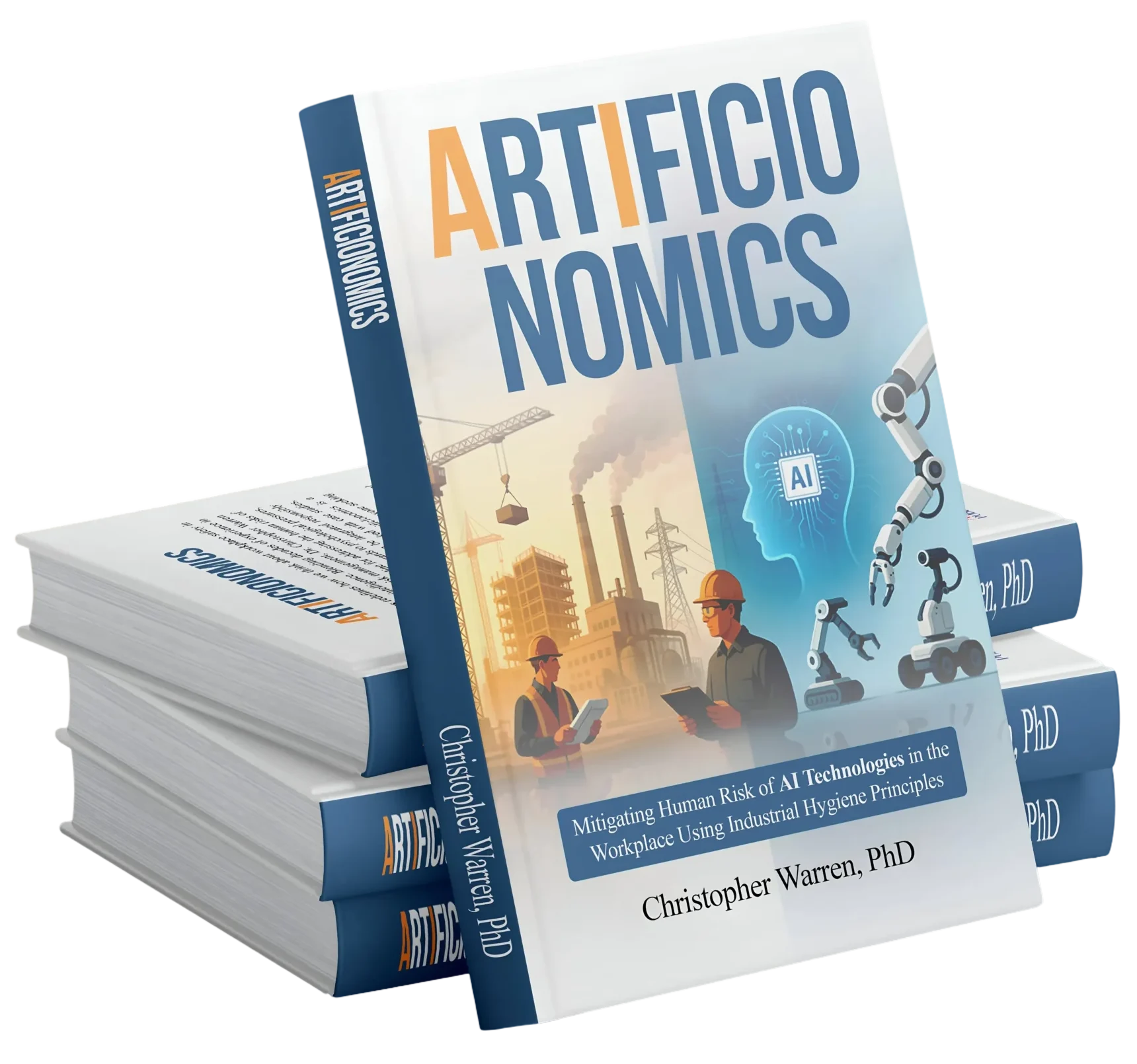
In ArtificIonomics: Mitigating Human Risk of AI Technologies in the Workplace Using Industrial Hygiene Principles, Christopher Warren, PhD, introduces a pioneering approach that extends the proven principles of industrial hygiene into the age of artificial intelligence. Rather than treating AI solely as an operational advantage, the book recognizes it as a new category of workplace exposure requiring systematic risk identification, evaluation and control.
The framework expands traditional occupational health practices to include emerging challenges such as human-robot interaction, algorithmic surveillance, cognitive workload, psychosocial stress and ethical AI governance. By adapting familiar concepts like hazard assessment and the hierarchy of controls, ArtificIonomics provides organizations with practical strategies to protect workers while embracing intelligent automation.
For logistics companies, this perspective is becoming increasingly valuable. Investing in robotics alone is not enough. Organizations must also invest in AI literacy, transparent workplace policies, worker involvement, ergonomic system design and continuous evaluation of both physical and psychological risks. When employees understand how AI supports their work and when they trust the systems around them, automation becomes a tool for empowerment rather than uncertainty.
Amazon demonstrated what the future of logistics could look like.
The next challenge is ensuring that the future is built around people as much as technology.
As warehouses become smarter, success will no longer be measured only by delivery speed or operational efficiency. It will also be measured by how effectively organizations protect the health, well-being and dignity of the workforce operating alongside intelligent machines.
ArtificIonomics offers a timely roadmap for that future, showing that the most resilient logistics operations will be those where innovation and worker safety advance together, not in competition, but in partnership.