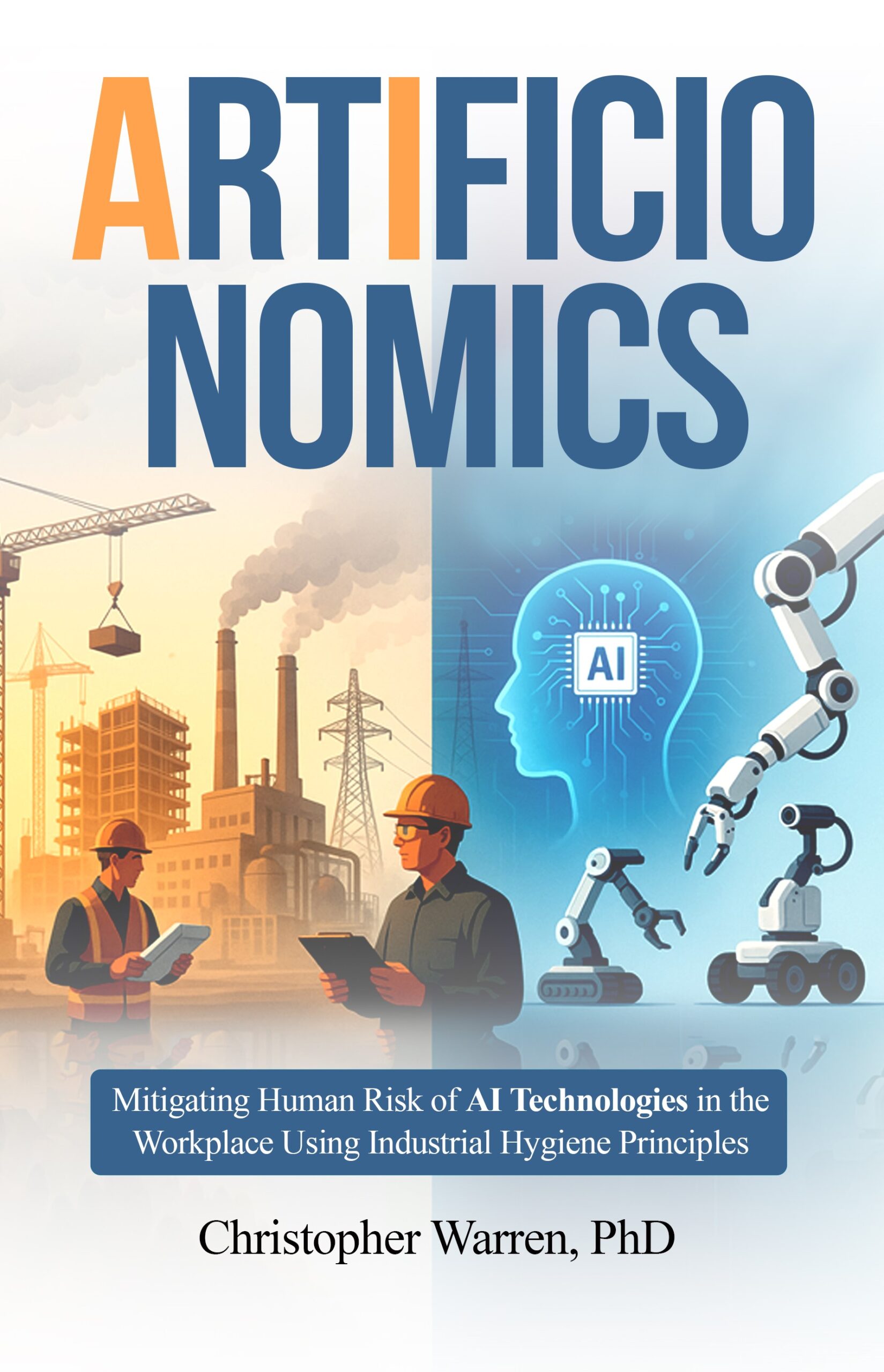
Artificionomics: Mitigating Human Risk of AI Technologies in the Workplace Using Industrial Hygiene Principles
Most books about artificial intelligence focus on innovation, efficiency, or ethics in the abstract. Very few address what happens when AI systems enter the daily reality of work and begin shaping safety, health, and human decision-making. Artificionomics stands apart by doing exactly that. Christopher Warren introduces a much-needed framework that treats AI not as a neutral tool but as a source of occupational exposure that must be managed with the same rigor applied to traditional workplace hazards.
What Makes This Book Different?
What immediately distinguishes Artificionomics is its grounding in industrial hygiene and occupational safety science. Rather than proposing an entirely new risk philosophy, Warren adapts proven principles that safety professionals already understand and apply. Exposure assessment, hazard recognition, the hierarchy of controls, and continuous monitoring are all applied in the context of AI-driven systems.
This approach makes the book practical rather than theoretical. Readers are not asked to speculate about future risks but to recognize those already present in scheduling algorithms, performance monitoring tools, predictive analytics, and autonomous systems.
Clear Structure and Logical Progression
The book is carefully structured, moving from foundational concepts into applied practice. Early chapters establish how AI changes work and introduces new forms of risk that are often invisible. Later sections address governance, legal responsibility, emergency response, sustainability, and professional development.
Each chapter builds on the previous one, reinforcing the idea that AI risk management is not a single policy or tool, but an integrated system that encompasses leadership, workers, regulators, and technology developers.
A Strong Focus on Human Impact
One of the book’s greatest strengths is its consistent focus on people. Warren repeatedly brings the discussion back to how AI affects cognitive load, trust, fatigue, autonomy, and dignity. These issues are often dismissed as soft concerns; yet, the book convincingly demonstrates how they directly impact safety outcomes.
By framing psychosocial and cognitive effects as legitimate occupational exposures, Artificionomics elevates conversations that are long overdue in safety practice.
Who Should Read This Book?
This book is highly relevant for occupational health and safety professionals, industrial hygienists, and risk managers. It is equally valuable for executives, compliance leaders, and regulators who oversee AI deployment, yet often lack a clear understanding of its human consequences.
This book is also valuable for technology leaders and developers will also benefit from reading it, particularly those working in high-risk environments such as construction, healthcare, manufacturing, and logistics.
Artificionomics succeeds in defining a new discipline while remaining grounded in familiar safety science. It does not argue against the adoption of AI. Instead, it provides a roadmap for responsible integration that protects workers and organizations alike.
For anyone involved in the future of work, Artificionomics: Mitigating Human Risk of AI Technologies in the Workplace Using Industrial Hygiene Principles is not only informative but also essential. It is essential, as it can help us shape the next generation of AI technology and its safety.
For more details visit our website: https://artificionomics.com/