Artificial Intelligence is rapidly transforming the modern workplace. From manufacturing floors and logistics centers to hospitals, construction sites and corporate offices, AI is helping organizations automate processes, improve efficiency and make faster decisions.
The benefits are undeniable.
AI-powered systems can predict equipment failures, optimize workflows, assist with complex decision-making and even reduce exposure to certain physical hazards. As a result, businesses across virtually every industry are investing heavily in intelligent technologies to improve productivity and remain competitive.
But while organizations focus on the operational advantages of AI, many are overlooking an important reality:
Artificial Intelligence is creating an entirely new category of occupational health challenges.
For decades, occupational health professionals have focused on hazards such as chemical exposures, noise, heat stress, repetitive motion injuries and ergonomic risks. These threats were visible, measurable and generally well understood.
Today’s AI-driven workplace presents a different challenge.
Many of the risks associated with AI are less visible but equally significant.
One of the most pressing concerns is psychological stress.
As AI systems increasingly monitor performance, allocate tasks, evaluate productivity and influence workplace decisions, employees often find themselves working under a level of digital oversight that previous generations never experienced. While these tools can improve accountability and efficiency, they can also create feelings of constant surveillance and pressure.
Workers may begin to feel that every action is being measured, every decision evaluated and every performance metric scrutinized by an algorithm.
Over time, this can contribute to anxiety, emotional fatigue and burnout.
Another emerging challenge is cognitive overload.
Employees are being asked to interact with increasingly complex systems while simultaneously adapting to rapid technological change. AI-generated recommendations, alerts, dashboards and automated workflows require constant attention and interpretation. While these systems are designed to assist workers, they can also increase mental workload and decision fatigue when not properly managed.
Job insecurity represents another significant occupational health concern.
As automation continues to reshape industries, many workers worry about how AI will affect their roles in the future. Even when organizations have no immediate plans to reduce staffing, uncertainty about technological change can create chronic stress that impacts both mental well-being and job performance.
Human-robot interaction also introduces new occupational considerations.
Collaborative robots, autonomous vehicles and intelligent machines are increasingly sharing workspaces with people. While these technologies can reduce certain physical risks, they also create new challenges involving trust, communication, situational awareness and safe interaction between humans and machines.
Perhaps most importantly, AI can affect workplace culture itself.
When employees perceive that important decisions are being made by algorithms rather than people, trust can erode. Workers may feel less connected to leadership, less empowered in their roles and less confident in organizational decision-making processes.
These emerging risks require a new approach to occupational health and safety.
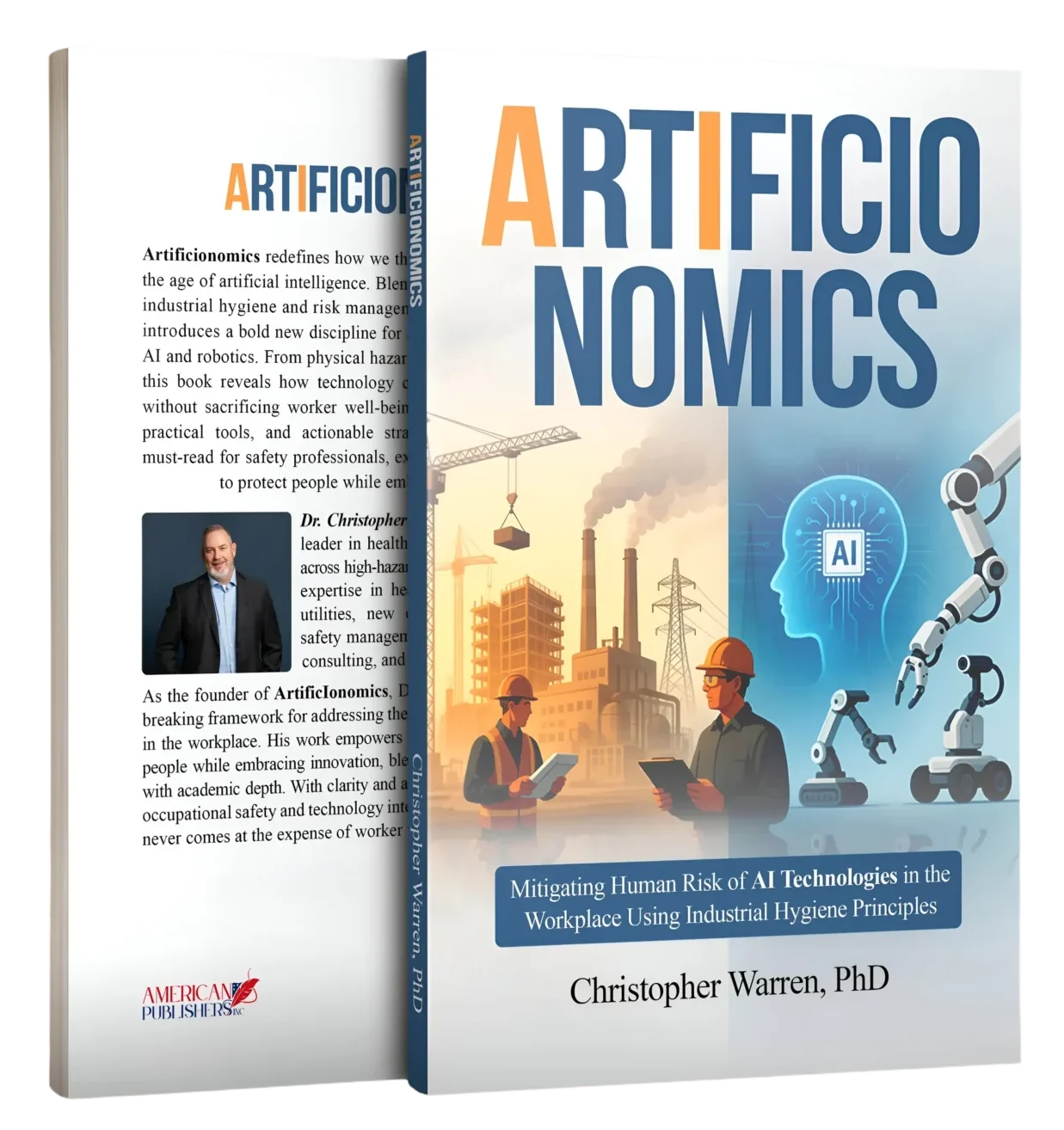
This is the focus of ArtificIonomics: Mitigating Human Risk of AI Technologies in the Workplace Using Industrial Hygiene Principles by Christopher Warren, PhD.
The book introduces ArtificIonomics, a groundbreaking framework that applies the proven principles of industrial hygiene to the human risks associated with artificial intelligence and robotics. Just as traditional industrial hygiene focuses on identifying, evaluating and controlling workplace hazards, ArtificIonomics expands those principles to address the psychological, cognitive, social, ethical and operational challenges created by intelligent technologies.
Rather than treating AI as simply a technological innovation, ArtificIonomics recognizes it as a workplace exposure that can significantly affect worker health, safety and well-being if left unmanaged.
The future of work will undoubtedly be shaped by artificial intelligence.
But the organizations that succeed will not be those that focus solely on machine performance.
They will be the ones that recognize, measure and manage the human impact of AI.
Because protecting workers in the age of intelligent technology requires more than innovation.
It requires a commitment to understanding and mitigating the new occupational health challenges AI is creating every day.