Artificial Intelligence is moving faster than regulation.
Organizations around the world are deploying AI-powered tools to automate tasks, improve decision-making, monitor performance, optimize operations and reshape how work gets done. From hiring algorithms and employee monitoring systems to predictive analytics and intelligent automation, AI is becoming deeply embedded in the modern workplace.
But while businesses race to adopt these technologies, governments and regulators are racing to catch up.
A new wave of AI workplace regulations is coming and organizations that fail to prepare may find themselves facing legal, operational and reputational risks they never anticipated.
Why Regulators Are Paying Attention
For years, AI was viewed primarily as a technology issue.
Today, regulators increasingly recognize that AI is also a workplace issue.
The reason is simple: AI systems affect people.
They influence hiring decisions, performance evaluations, scheduling, compensation, promotions, workplace surveillance and employee communications. In some cases, AI may determine opportunities for advancement or even whether an individual remains employed.
As these technologies become more powerful, concerns about fairness, transparency, privacy, accountability and worker protection continue to grow.
Regulators are asking critical questions:
- Can AI systems discriminate?
- Are employees being monitored appropriately?
- Who is accountable when AI makes harmful decisions?
- How transparent should automated systems be?
- What protections exist for workers affected by AI?
These questions are rapidly moving from policy discussions into regulatory frameworks.
The Global Regulatory Landscape Is Evolving
Around the world, governments are developing rules designed to govern the use of artificial intelligence.
The European Union’s AI Act has already established one of the most comprehensive regulatory frameworks for AI, introducing risk-based requirements for organizations deploying certain AI systems.
In the United States, federal agencies and state governments are increasing scrutiny of AI applications in hiring, employment practices, consumer protection and workplace monitoring.
Many countries are also exploring regulations focused on algorithmic transparency, data privacy, automated decision-making and employee rights.
While specific requirements may differ across jurisdictions, one trend is clear:
Organizations will be expected to demonstrate responsible AI governance.
Compliance Alone Will Not Be Enough
Many leaders view AI regulation primarily as a legal challenge.
That perspective may be too narrow.
Compliance addresses minimum requirements. Trust requires something more.
Even if an organization satisfies regulatory obligations, employees may still experience anxiety, stress, confusion or frustration when interacting with AI systems. Workplace surveillance, algorithmic management and automated decision-making can affect morale, engagement and psychological well-being in ways regulations may not fully address.
The organizations that succeed in the AI era will not simply comply with regulations.
They will proactively manage the human impact of AI.
Introducing Artificionomics
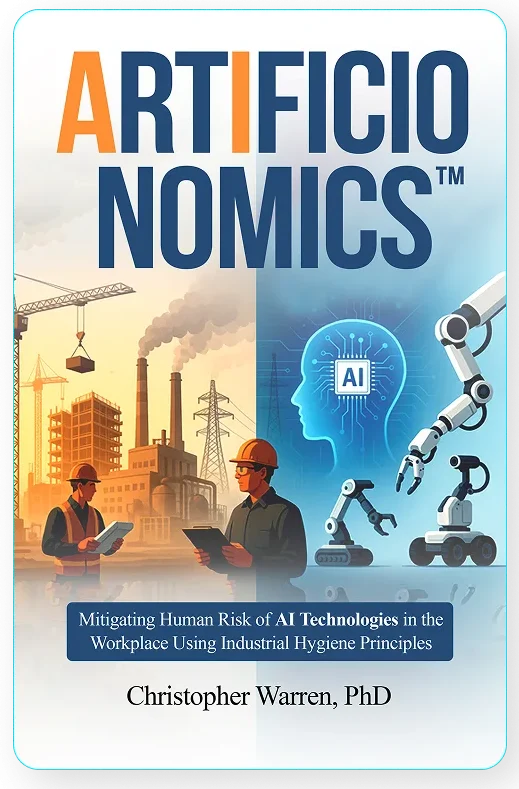
This challenge is at the heart of Artificionomics: Mitigating Human Risk of AI Technologies in the Workplace Using Industrial Hygiene Principles by Christopher Warren, PhD.
In the book, Warren introduces Artificionomics, a pioneering framework designed to help organizations identify, evaluate and control the human risks associated with artificial intelligence and robotics.
Drawing upon industrial hygiene principles, Artificionomics expands the conversation beyond compliance and governance. It examines how AI affects employee well-being, workplace trust, cognitive load, mental health and organizational culture.
The framework encourages leaders to ask a deeper question:
Not just “Is our AI compliant?” but “Is our AI safe for the people who use it?”
Preparing for the Future
The coming wave of AI workplace regulations is not a temporary trend. It represents the beginning of a new era of accountability.
Organizations that wait for regulations to dictate their approach may find themselves constantly reacting to change. Those that adopt human-centered AI strategies today will be better positioned to navigate future requirements while building trust with employees, customers and stakeholders.
AI will continue to transform the workplace.
The challenge for leaders is ensuring that innovation moves forward responsibly.
Artificionomics offers a roadmap for doing exactly that, helping organizations prepare not only for the regulations of tomorrow, but for the human realities of an AI-driven future.