Artificial intelligence is rapidly becoming embedded in the fabric of modern work. From automated scheduling systems and predictive analytics to AI-driven hiring tools and real-time performance monitoring, intelligent systems now influence how decisions are made across nearly every industry. These technologies are often introduced as solution tools that improve efficiency, reduce physical risk and streamline operations.
Yet behind these benefits lies a set of invisible dangers that are increasingly shaping the human experience of work.
Unlike traditional workplace hazards, AI-related risks are not always visible or immediate. They do not typically involve machinery failures or physical injuries. Instead, they manifest in more subtle but deeply impactful ways affecting mental health, reinforcing bias and creating cognitive overload.
One of the most pressing concerns is mental health strain in AI-monitored environments. Many organizations now use AI systems to track employee performance in real time. These systems measure productivity, monitor behavior and evaluate output continuously. While this may enhance efficiency, it also creates an environment where employees may feel constantly observed and assessed.
Over time, this persistent sense of surveillance can contribute to stress, anxiety and emotional fatigue. Workers may begin to feel that they are operating under continuous evaluation, where every action is quantified and analyzed. The result is often reduced autonomy and increased psychological pressure, even in roles that are not physically demanding.
Another invisible danger is algorithmic bias. AI systems are trained on historical data and if that data reflects existing inequalities, those biases can be reinforced and amplified in decision-making processes. This can affect hiring, promotions, task assignments and performance evaluations.
The challenge is not only technical, but it is also ethical. When biased systems operate without transparency, workers may experience unfair outcomes without understanding the source. This can lead to frustration, disengagement and a deep erosion of trust in organizational systems. Over time, bias in AI can quietly shape workplace culture in ways that are difficult to detect but highly consequential.
A third major concern is cognitive overload. As AI systems become more integrated into daily workflows, employees are often required to interact with multiple platforms, dashboards, alerts and automated recommendations. Instead of simplifying work, this can sometimes make it more mentally demanding.
Constant notifications, real-time updates and rapid decision cycles can overwhelm attention and reduce the ability to focus deeply. In high-pressure environments, this overload contributes to fatigue, reduced decision quality and diminished well-being.
Global institutions are increasingly acknowledging these challenges. The World Economic Forum has emphasized that AI will significantly reshape labor markets and workplace structures, requiring new approaches to workforce adaptation. Similarly, McKinsey & Company has highlighted the risk of burnout, workforce stress and organizational disruption if AI adoption is not carefully managed.
These concerns reveal a critical gap in traditional safety thinking. Conventional workplace safety frameworks were designed to address physical hazards, not the psychological and cognitive risks introduced by intelligent systems.
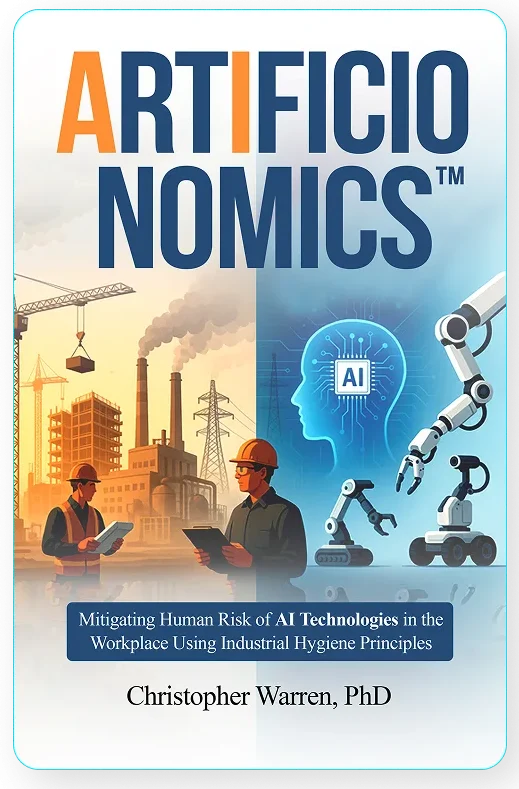
This is where the work of Christopher Warren becomes especially relevant through his groundbreaking book ArtificIonomics.
ArtificIonomics introduces a new framework for understanding workplace safety in the age of artificial intelligence and robotics. It expands industrial hygiene principles beyond physical risks to include cognitive, psychological and ethical dimensions of modern work environments.
At its core, the framework is built on three essential steps: identify, evaluate and control. Organizations must first identify AI-related risks such as surveillance pressure, algorithmic bias, cognitive overload and reduced autonomy. Next, these risks must be evaluated using both operational metrics and human-centered indicators like trust, fairness perception and mental well-being. Finally, control strategies must be implemented through transparent AI governance, ethical system design and workforce support systems that prioritize human health.
The goal of ArtificIonomics is not to slow down technological progress, but to ensure it develops responsibly. AI should enhance human capability, not quietly undermine mental health, reinforce bias or overwhelm attention.
As workplaces continue to evolve, understanding these invisible dangers becomes essential. ArtificIonomics provides the tools to see them clearly and the framework to address them before they become irreversible.
Available On Amazon: https://www.amazon.com/dp/B0GFY4RL6B/