As intelligent systems become part of everyday operations, organizations are under increasing pressure to balance performance with responsibility. While these systems can enhance efficiency and decision-making, they also introduce risks that affect employees in ways that are not always immediately visible. Reducing these risks requires a deliberate and structured approach that places people at the center of implementation.
The first step is to design with purpose, not just performance. Many organizations adopt new systems to improve speed or reduce costs, but overlook how these tools shape the employee experience. Before implementation, leaders should evaluate how the system will affect workload, decision-making, and mental strain. A well-designed system supports employees rather than overwhelming them. Simplicity, clarity, and reliabilty should be treated as essential features, not optional enhancements.
The second step is to establish clear boundaries for use. Without defined limits, systems can expand into areas that create unnecessary pressure or confusion. Organizations should determine where automation is appropriate and where human judgment must remain central. This includes setting rules around decision-making authority, monitoring practices, and data usage. Clear boundaries reduce uncertainty and help employees understand their role within the system.
The third step is to prioritize transparency at every level. Employees are more likely to trust systems when they understand how they work and why they are used. This means explaining how decisions are generated, what data is being collected, and how that data influences outcomes. Transparency is not just about sharing information. It is about creating an environment where employees feel informed rather than observed.
The fourth step is to invest in meaningful training. Introducing advanced systems without proper guidance creates confusion and resistance. Training should go beyond basic functionality and focus on building confidence. Employees need to understand not only how to use the system, but also how to interpret its outputs and when to question them. When people feel capable, they are more likely to engage with new tools in a productive way.
The fifth step is to continuously monitor human impact, not just system performance. Many organizations measure success through efficiency metrics alone, but this provides an incomplete picture. It is equally important to assess how systems affect stress levels, workload balance, and overall job satisfaction. Regular feedback from employees can reveal issues that data alone cannot capture. This allows organizations to make adjustments before small concerns become larger problems.
Reducing workplace risks is not a one-time effort. It is an ongoing process that requires attention, adaptation, and commitment. Organizations that take a proactive approach will not only protect their workforce, but also create environments where innovation can thrive without unintended consequences.
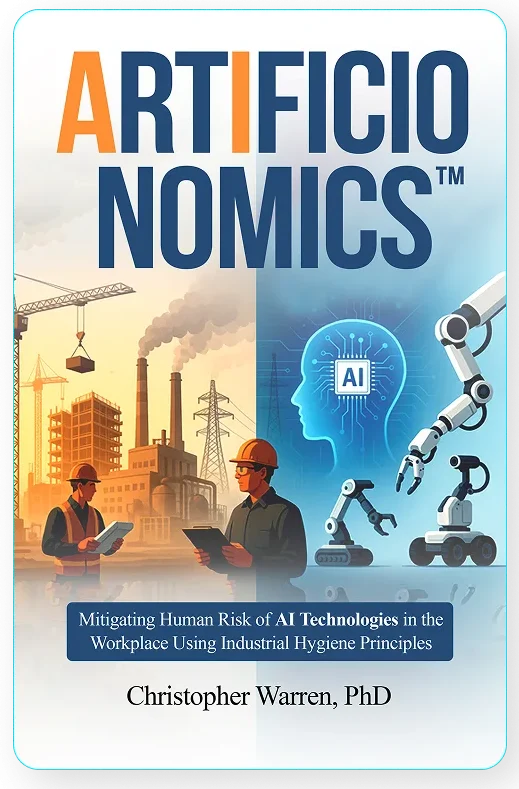
This approach is central to Artificionomics: Mitigating Human Risk of AI Technologies in the Workplace by Christopher Warren, PhD. The book provides a practical framework for managing modern workplace risks by combining established safety principles with the realities of intelligent systems. It offers organizations a clear path to adopt new technologies responsibly while maintaining trust, well-being, and long-term performance.
Get your Copy Now on Amazon: https://www.amazon.com/dp/B0GFY4RL6B