The modern workplace is evolving rapidly, driven by intelligent systems that promise efficiency, accuracy, and speed. While the benefits are widely discussed, the hidden risks often go unnoticed until they begin to affect people in subtle but significant ways. These dangers are not always technical. Many of them are human, psychological, and cultural.
The first danger is invisible pressure. When systems continuously measure performance, employees may feel that every action is being evaluated. This creates a constant sense of urgency that does not fade at the end of a task. Over time, this pressure can lead to anxiety and reduced confidence, even among high performers.
The second danger is loss of autonomy. When decisions are guided or pre-structured, employees may feel that their role is shifting from thinking to following. This can reduce engagement and limit the ability to apply personal judgment. Work becomes less about contribution and more about execution.
The third danger is reduced human interaction. As communication becomes more automated and streamlined, opportunities for real conversation decrease. Collaboration may become efficient, but it also becomes less personal. This can weaken team relationships and create a sense of isolation within the workplace.
The fourth danger is over-reliance on systems. When recommendations are consistently accurate, it becomes easy to accept them without question. This can gradually reduce critical thinking. Employees may stop challenging outputs, leading to decisions that are accepted quickly but not always understood fully.
The fifth danger is blurred accountability. When outcomes are influenced by systems, it becomes unclear who is responsible for the final result. If something goes wrong, is it the system or the individual who made the decision? This uncertainty can create hesitation and reduce confidence in decision-making.
The sixth danger is cognitive overload. Constant notifications, real-time feedback, and continuous data input can overwhelm the mind. Employees are required to process more information than ever before, often without adequate time to reflect. This can lead to mental fatigue and decreased productivity over time.
The seventh danger is loss of purpose. As systems take over more structured tasks, employees may begin to question their value. If their role becomes focused on monitoring or adjusting outputs, the sense of ownership and achievement can diminish. This affects motivation and long-term engagement.
These risks are not always obvious because they develop gradually. They are not tied to a single event, but to repeated exposure over time. Without awareness, organizations may focus on performance improvements while overlooking the impact on their workforce.
Addressing these challenges requires a shift in perspective. It is not enough to introduce advanced systems and expect positive outcomes. Organizations must actively design environments that support human well-being alongside performance. This includes clear boundaries, transparent practices, and a strong emphasis on human judgment.
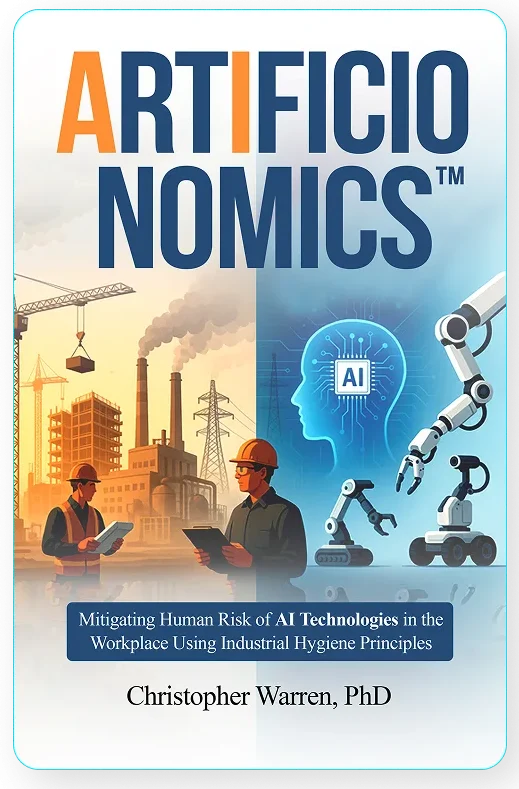
This is where Artificionomics: Mitigating Human Risk of AI Technologies in the Workplace by Christopher Warren, PhD, provides essential guidance. The book offers a structured approach to identifying and managing risks that affect people, not just processes. It bridges the gap between innovation and responsibility, showing how organizations can adopt new technologies without compromising the human experience.
The future of work is not defined by technology alone.It is defined by how people experience it. Recognizing these hidden dangers is the first step toward building workplaces that are not only efficient, but also sustainable and human-centered.
Get your Copy Now on Amazon: https://www.amazon.com/dp/B0GFY4RL6B